

FAQs
Find answers to frequently asked questions.
About INDUCE-seq®
-
INDUCE-seq® is a genome-wide assay that maps DNA double-strand breaks (DSBs) induced by gene editing. It enables researchers to identify both on- and off-target DNA breaks with high sensitivity across discovery through to IND-enabling studies.
For more information, read our INDUCE-seq® Technical Overview
-
INDUCE-seq® captures DSBs generated by any genome editing system, allowing the same assay to be used across multiple editing platforms. Cell types tested include:
Both adherent and suspension cells
Primary, Stem and Immortalized cells from diverse tissues
Therapeutically relevant cells including T Cells, Hepatocytes, HSPCs, and iPSCs.
For more information, read our Designing INDUCE-seq® Experiments Technical Note
-
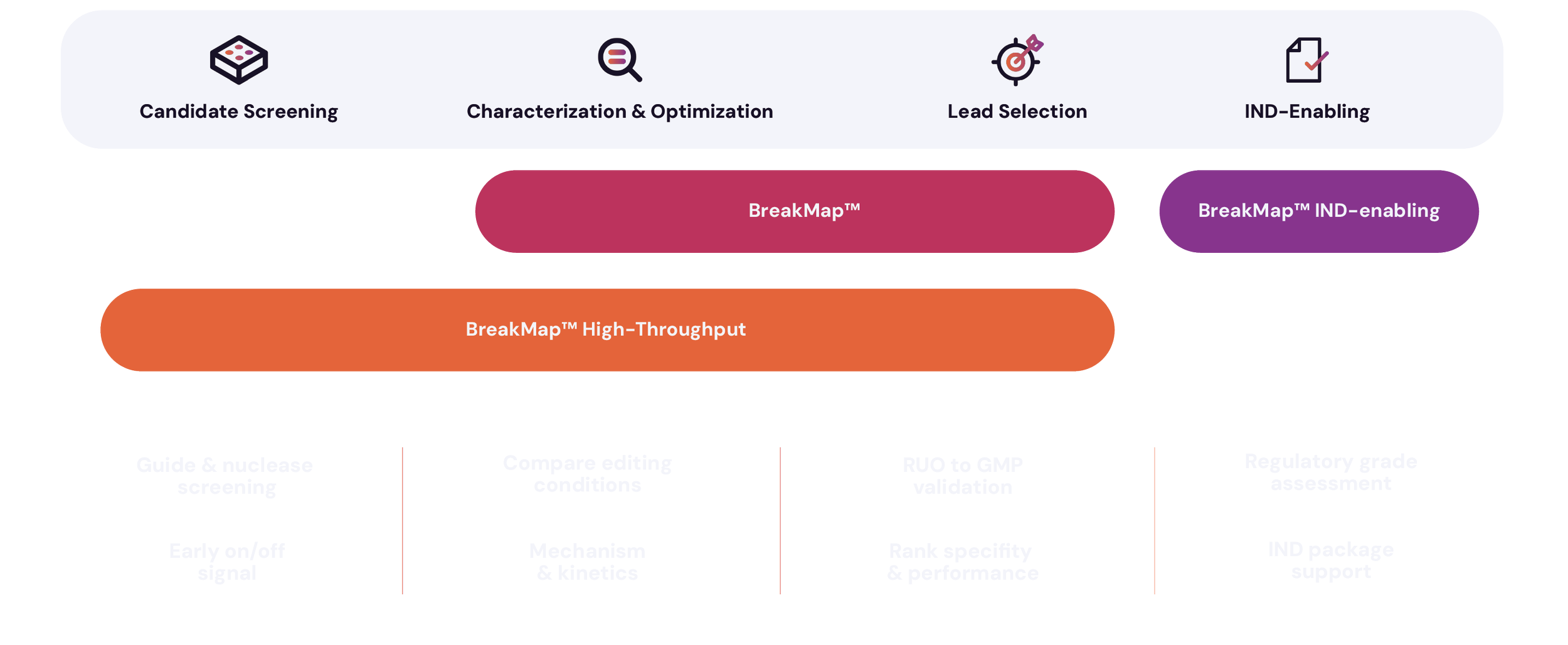
INDUCE-seq® can be used throughout the development of gene editing programs from guide screening and nuclease development, on- and off-target validation, editing strategy optimization, RUO-to-GMP guide validation, and preclinical development.
<img src="https://images.squarespace-cdn.com/content/69429e7198b87e513d8a40ea/e9802047-ed63-4332-a81e-b30af0494dae/BSB-Pipeline-2026-whitel.png?content-type=image%2Fpng" style="max-width: 70%; height: auto; border-radius: 8px; margin-top: 40px; display: block;" />
-
INDUCE-seq® is PCR-free: proprietary adapters label double-strand breaks directly in situ and breaks are enriched on the sequencing flow cell. This produces a linear, one-read-per-break signal while avoiding the amplification bias associated with PCR-based methods.
-
GUIDE-seq relies on live cells that efficiently incorporate a dsODN tag at sites of DNA damage, which can make it difficult to apply in some therapeutically relevant cell types. INDUCE-seq® uses fixed cells and a PCR free workflow providing direct measurement of DNA breaks across a broader range of cell types.
Compatibility
-
INDUCE-seq® is nuclease agnostic, supporting any double-strand break generating system. We have ample experience with Cas9, Cas12, novel Cas nucleases, and TALENS.
-
INDUCE-seq® has been used across a wide range of immortalized, primary and clinically relevant cell types.
-
Yes, INDUCE-seq® has been successfully applied to bone marrow, glioblastoma, neurons, lung carcinoma, T cells, fibroblasts, and hepatocytes.
-
Yes, INDUCE-seq® can detect single strand breaks associated with base editing and we currently offer early access solutions for ABE and CBE programs.
Further information can be found here
Workflow
-
INDUCE-seq® uses sedimented, immobilized, PFA-fixed edited cells. Input cell numbers depend on cell size and the need to maintain an intact monolayer.
-
We have validated success using the following Poly-D-Lysine coated plates- Greiner Bio-One (655940) and Corning (356461). Please see their vendor websites for full dimensions.
-
The INDUCE-seq® assay can be completed in 2 days, with flexible safe stopping points. Sequencing runs typically take anywhere from 12-24 hours depending on your sequencing configuration.
-
INDUCE-seq® can be performed in a standard molecular biology laboratory with access to a compatible Illumina NextSeq 500/550 or 2000 sequencing platform(s), and a mechanical shearing instrument such as a Covaris, Bioruptor, or Pixul (or equivalent).
A full equipment list can be found here
-
INDUCE-seq® is optimized for the Illumina NextSeq 500/550 and NextSeq 2000, selected for their molecule capture efficiency, which is critical to assay sensitivity. It is not compatible with the MiSeq or iSeq. Customers should speak with their scientific advisor about compatibility with other sequencing systems.
Results
-
You’ll receive a list of ranked genomic break sites together with visualizations and supporting meta-data, to help interpret on-target and off-target editing events.
You can view a sample report here
-
Yes. Because results are ranked by break frequency, on-target sites are clearly separated at the top of the list from lower-frequency off-target events in the same output.
-
INDUCE-seq® is PCR-free, and avoids the amplification bias and background noise that can limit sensitivity in PCR-based methods, supporting detection of low-frequency off-target events that other assays can miss.
Getting Started
-
Yes. INDUCE-seq® is designed to run in a standard molecular biology lab with access to NGS, no specialized equipment is needed beyond a mechanical shearing instrument and a compatible sequencer.
-
Yes. INDUCE-seq® is available as a service through our UK laboratory.
-
Discussing a project with our team is easy. You can find all the ways to get in touch with our team via our contact page here.